Independent SS316L Thermal-History Validation
A 42-layer SS316L wall provides a second, materially different test of Baal Hammon Thermomechanics at 800 W, with a 7.92% peak-to-peak-normalized RMSE.
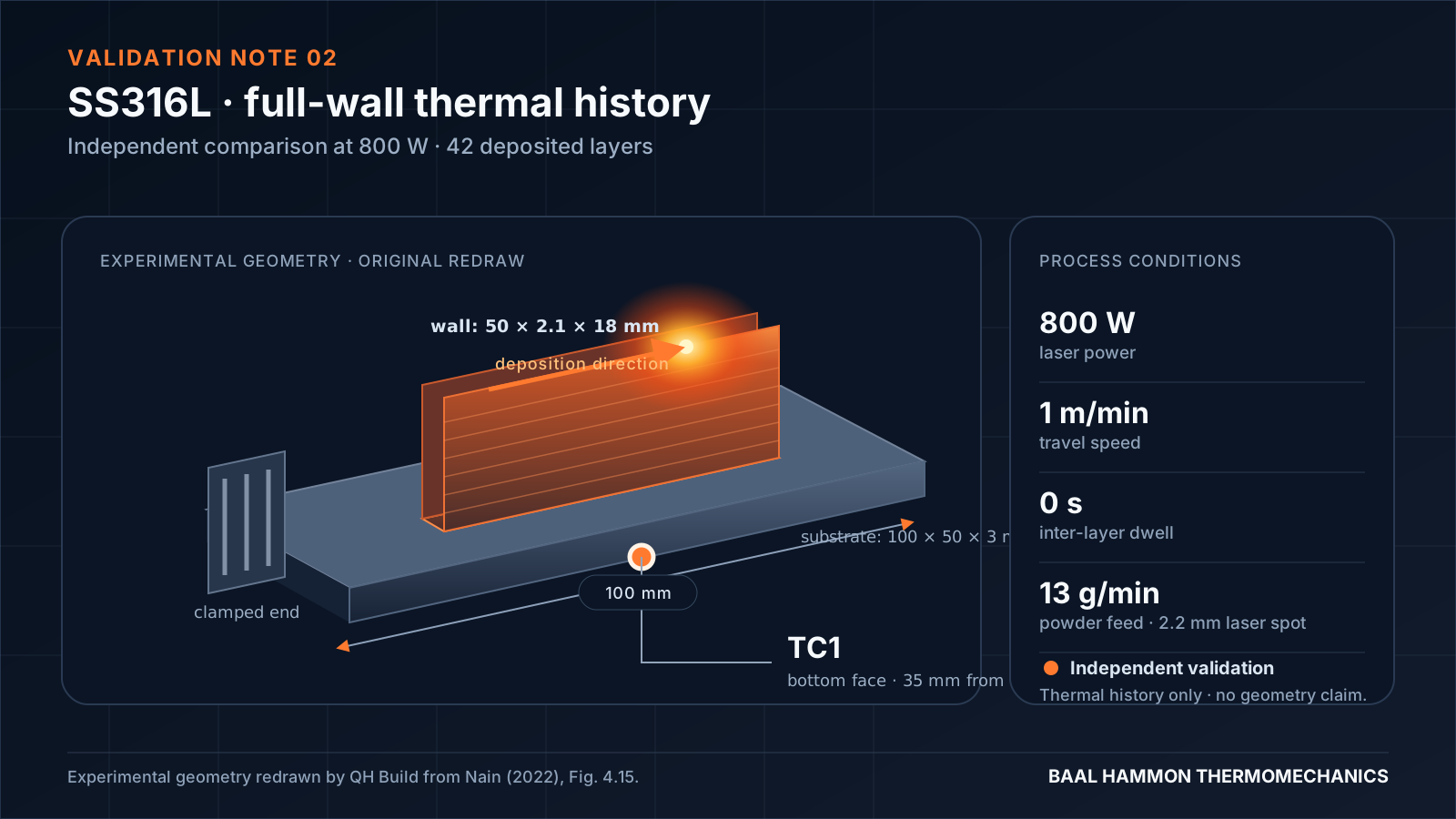
A model that agrees with one alloy may still be relying on the conveniences of that case. A stronger test changes the material, geometry, process schedule and thermal-property set while preserving a transparent validation method.
This second case evaluates Baal Hammon Thermomechanics against the measured thermal history of a 42-layer SS316L wall deposited at 800 W.
The result is a 7.92% NRMSE over the aligned thermal-history samples.
The full-wall experiment
Both the deposited wall and substrate are SS316L. The 50 × 2.1 × 18 mm wall is built on a 100 × 50 × 3 mm substrate using a 1 m/min travel speed, 13 g/min powder feed and a 2.2 mm laser spot.
There is no inter-layer dwell in this validation case. TC1 is mounted on the bottom face of the substrate, 35 mm from the free end.
Measured versus simulated thermal history
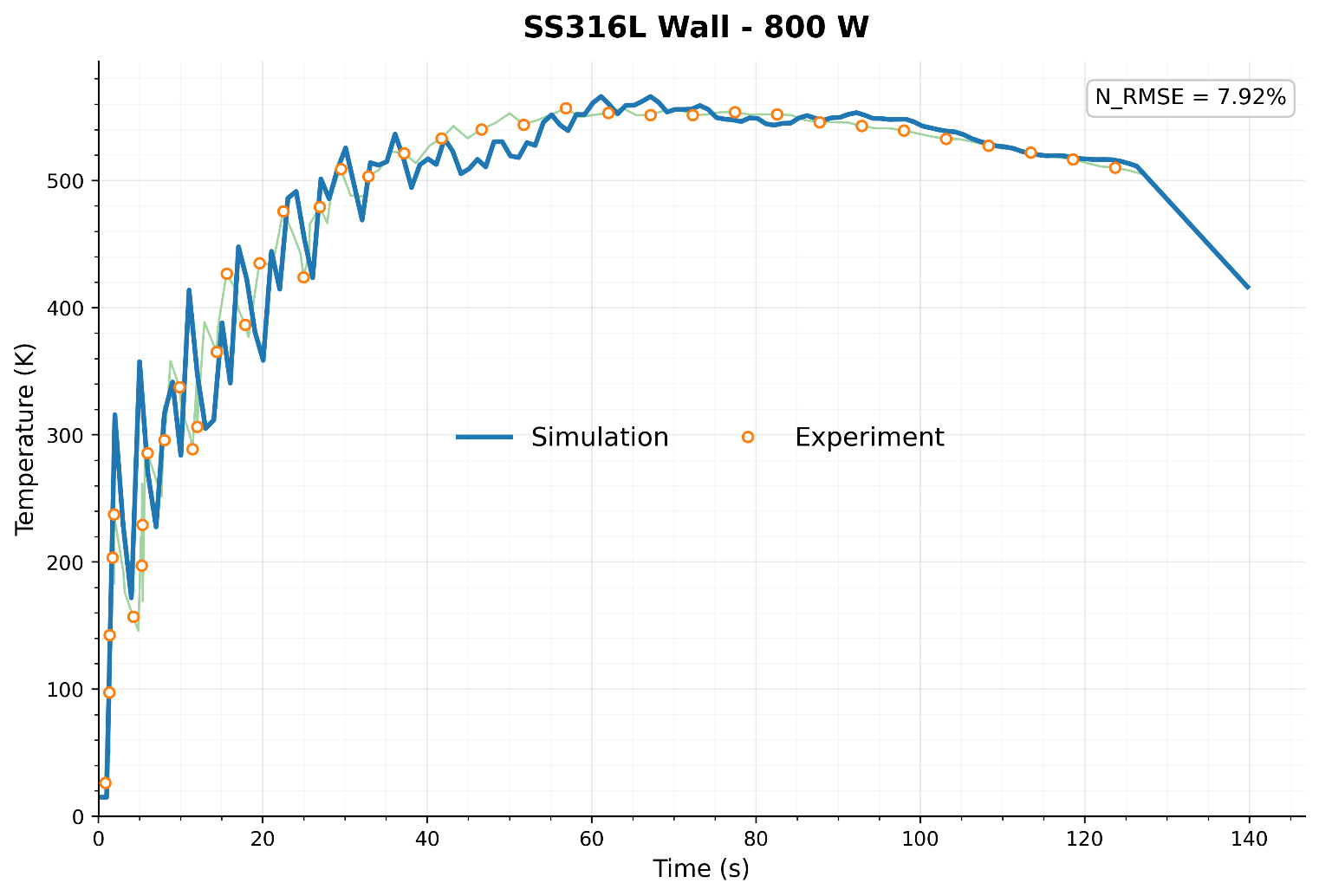 Baal Hammon prediction and experimental TC1 measurements for the 800 W SS316L wall, with a 7.92 percent NRMSE
The blue curve is the Baal Hammon prediction. Orange markers are the experimental TC1 measurements. TC2 reported the same response, and TC1 is used for the displayed comparison.
The measured series was not shifted, smoothed, interpolated or resampled. The reported error uses the experimental peak-to-peak temperature range:
NRMSE = RMSE / [max(T_exp) − min(T_exp)] × 100
The displayed curve was not used to fit the model.
Reading the early oscillations
The rapid oscillations early in the history are consistent with repeated local heating and cooling as successive passes move over the wall while the thermocouple remains close to the active deposition region.
As the wall grows, the heat source moves farther from the substrate-mounted thermocouple. At the same time, heat accumulates across the wall and substrate. The individual pass response therefore becomes less dominant at TC1 and the measured history transitions toward a smoother, broader thermal cycle.
This is a physical interpretation of the observed signal—not a separately instrumented conclusion. The important validation result is that the simulation reproduces both regimes: the early cyclic response and the later accumulated heating and cooling trend.
Simulation in motion
The full sequence shows the 800 W moving heat source traversing the SS316L wall while the thermal field develops through the wall and substrate.
Baal Hammon 800 W SS316L wall simulation showing the moving heat source and evolving full-wall temperature field
Model and boundary conditions
The thermal model uses the same core formulation as the Ti-6Al-4V case:
- a Goldak volumetric heat source;
- an initial temperature of 300 K;
- temperature-dependent convection on the deposited build;
- a constant substrate convection value of 5 W·m⁻²·K⁻¹;
- radiation with an emissivity of 0.6;
- solidification latent-heat release;
- 0.25 mm refinement in the build region; and
- a 0.025 s time step.
Temperature-dependent SS316L properties were taken from the recommended-property compilation by K. C. Mills.
Calibration disclosure
Convection was the only fitted boundary parameter. It was not refitted separately for SS316L, and the displayed 800 W history was kept outside the fitting data.
That makes this case useful for more than reporting a low error value. It tests whether the solver and its material-property treatment can transfer to a second alloy and a substantially different full-wall thermal cycle.
What this case validates
The available SS316L evidence validates thermal history at TC1 for this 800 W, zero-dwell wall build. It does not validate melt-pool geometry, wall dimensions or distortion because those experimental quantities were not available for comparison.
Keeping that boundary explicit makes the result stronger, not weaker. The solver is being credited for what the evidence demonstrates—and no more.
Together with the Ti-6Al-4V case, the result shows the direction of the Baal Hammon platform: one transparent thermomechanical framework, tested across different materials and deposition conditions before it is used for manufacturing decisions.
Technical basis
- Vaibhav Nain, Efficient thermomechanical modeling of large parts fabricated by Directed Energy Deposition Additive Manufacturing processes, doctoral thesis (2022). Experimental Case 1 and TC1 thermal history.
- K. C. Mills, Fe-316 Stainless Steel, in Recommended Values of Thermophysical Properties for Selected Commercial Alloys (2002). DOI: 10.1533/9781845690144.135.
- Experimental geometry was redrawn by QH Build. Simulation imagery and comparison graphics are QH Build outputs.