One Digital Thread, Two Models: How We Bridged Robotics and Multiphysics
KDDM delivers fast controller-aware deposition prediction. MPDM resolves laser-material interaction, melt-pool dynamics and thermal behaviour. NVIDIA Omniverse connects them in one scene.
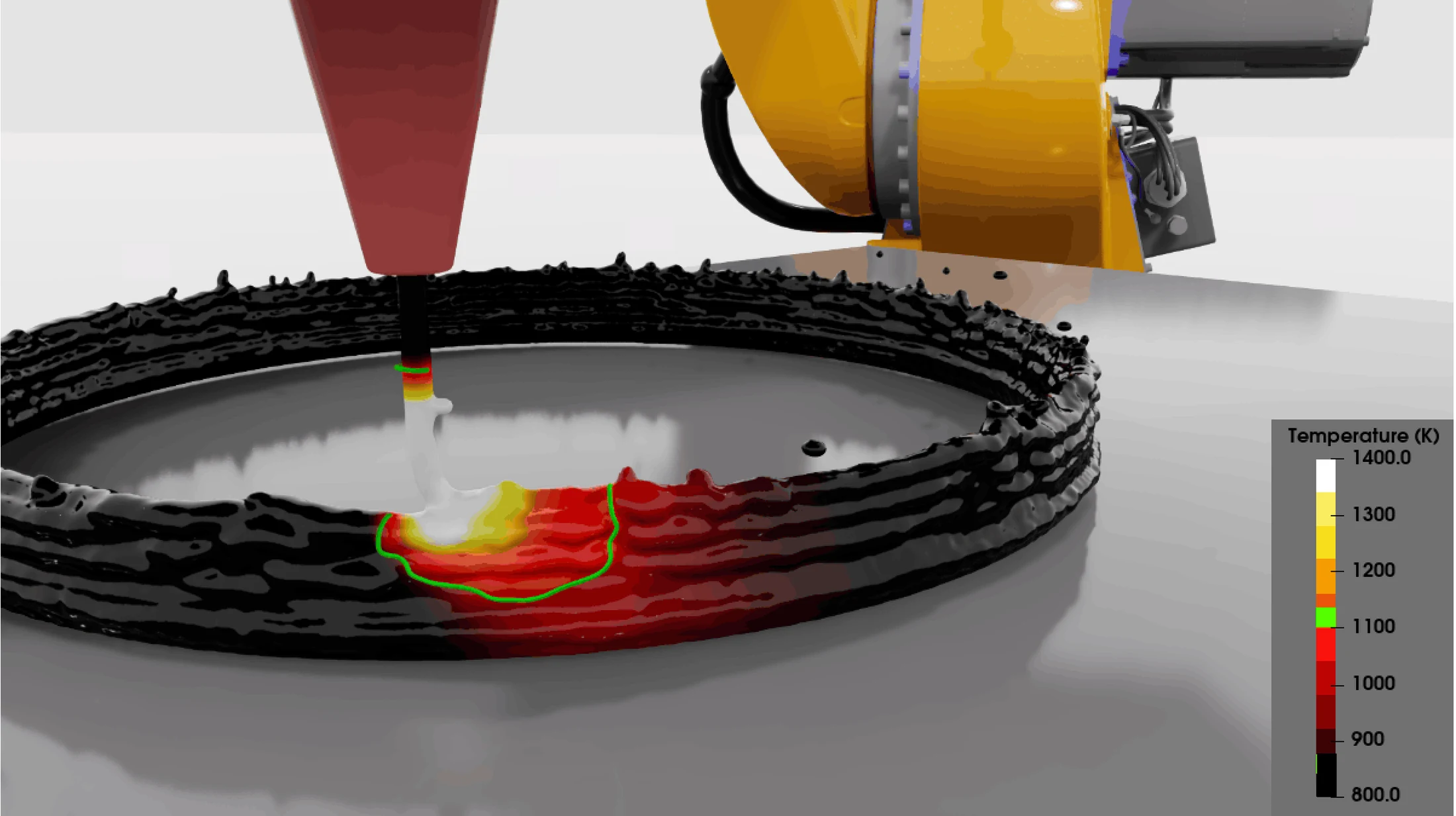
Robotic wire-laser additive manufacturing has a software problem hidden inside a manufacturing problem.
The robot, process head, CAM system, sensors and physics solver all describe the same build, but they describe it in different languages and at different time scales. The robot controller works in milliseconds. A high-fidelity melt-pool simulation may spend hours resolving a small section. CAM focuses on feasibility. Metrology sees the outcome after the fact.
Our work was to connect these components without pretending that one model could do everything.
Barrier one: controller reality versus ideal paths
A CAM path is an intention. The industrial controller turns that intention into acceleration profiles, blended corners, synchronized external-axis motion and discrete process commands.
Those details affect deposition. When the robot slows down but material feed remains constant, the bead becomes larger. When a start command has a delay, a gap can appear. When a positioner and robot share a movement, the local tool speed may differ from the nominal value.
We addressed this through the Kinematic and Dynamic Deposition Model (KDDM). It consumes real or replayed robot data, updates the robot and external axes in the digital scene, interprets deposition start-stop signals and creates material geometry based on actual motion.
KDDM is deliberately lightweight. It represents deposited material using efficient voxel-like primitives whose size can respond to speed and process state. This lets engineers inspect a complete path rapidly and identify motion-induced over-deposition, under-deposition or discontinuities before using an expensive physics solver.
Barrier two: geometry without physics
KDDM can show that too much material may accumulate in a corner. It cannot, by itself, determine whether the melt pool will remain stable, whether surface tension will reconnect two tracks, whether a layer will ball up or whether thermal history will distort the full part.
That is the responsibility of the Multiphysics Deposition Model (MPDM).
MPDM is based on the Baal Hammon solver suite. Its high-fidelity deposition component uses a particle-based approach to represent the wire, molten metal and evolving free surface. It includes laser energy deposition with multiple reflections, heat transfer, melting, solidification, evaporation, recoil pressure, surface tension and Marangoni effects.
A complementary finite-element component predicts larger-scale temperature evolution, residual stress and elastoplastic distortion.
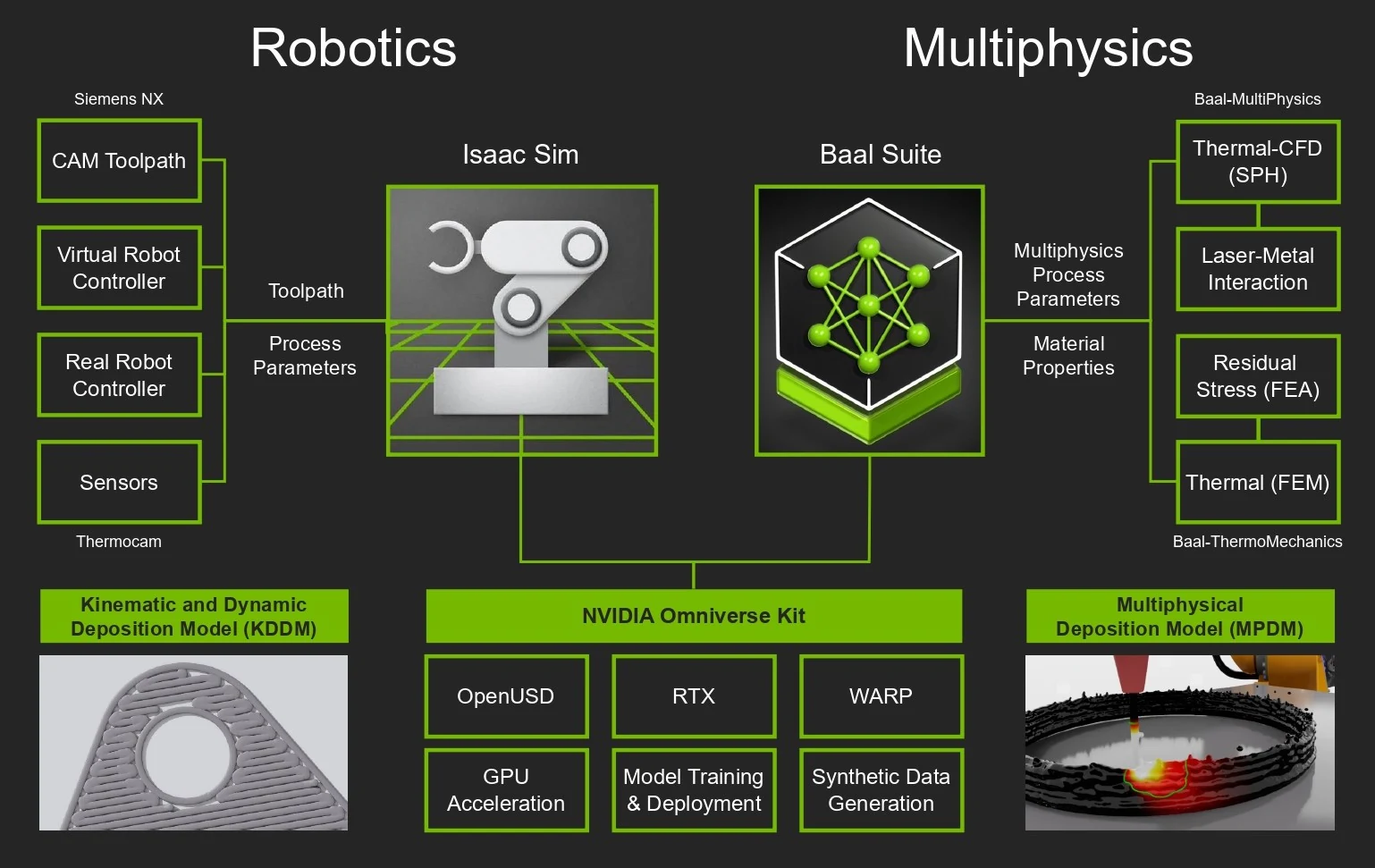 Architecture linking robotics, KDDM, MPDM and NVIDIA Omniverse
Barrier three: speed versus fidelity
High-fidelity simulation is valuable, but it should not be used where a faster model can answer the question.
Our pipeline therefore uses a hierarchy:
- CAM and virtual-controller checks reject impossible motions and collisions.
- KDDM evaluates the complete controller-aware deposition strategy quickly.
- MPDM investigates critical process windows, geometries and thermal effects in detail.
- Thermomechanical analysis evaluates full-part distortion after deposition and cooling.
- Physical measurement calibrates the models and validates predictions.
This hierarchy makes simulation economically useful. Fast models screen the design space; expensive models are applied where physics determines the decision.
Barrier four: isolated data
The models need a common digital environment. We selected NVIDIA Omniverse and OpenUSD so robots, tools, parts, deposited geometry, sensors and solver results can coexist in one synchronized scene.
NVIDIA Warp provides a GPU-native computing layer for the physics implementation. In the published work, individual solver components showed substantial acceleration, including up to a fivefold speed-up for the pressure Poisson stage and lower GPU-memory use for the large-scale thermomechanical model.
The result is not simply faster rendering. It is a practical environment in which a robotics engineer and a materials engineer can inspect the same build state.
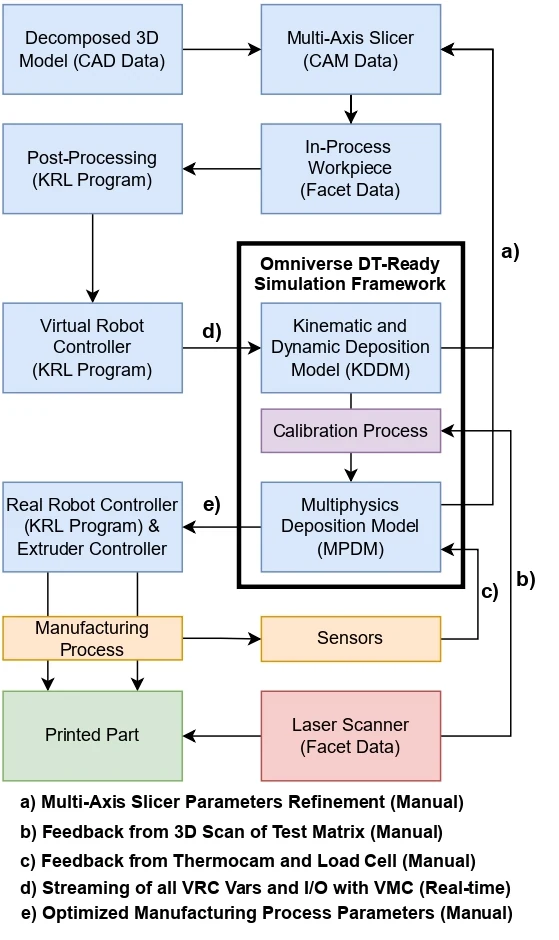 End-to-end workflow from CAD and robot control to sensors, scanning and feedback
Did the combined model match reality?
The framework was validated using physical wire-laser builds, robot data, thermal measurements and 3D scanning.
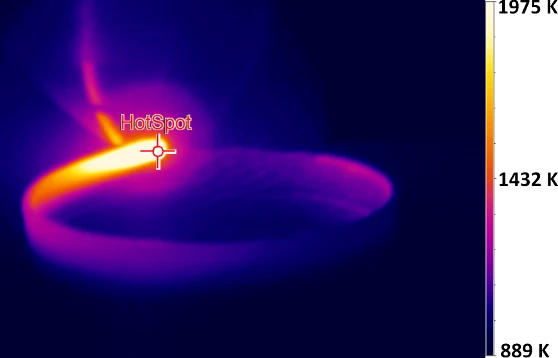 Thermal-history view used to compare the simulated process with physical evidence
KDDM reproduced defects associated with robot acceleration, blending, path curvature and deposition timing. MPDM reproduced process phenomena including blobbing, balling and discontinuous layers across different parameter conditions.
For five reported geometric indicators, prediction errors ranged from 0.45% to 16.10%, depending on the feature and test. The model also correctly identified non-viable combinations such as excessive standoff distance or mismatched power-to-velocity conditions before material was deposited.
On a production-scale case, simulation-guided parameters reduced deposition time by about threefold while maintaining or improving density and geometric accuracy compared with the investigated manufacturer-recommended baseline.
What has been solved - and what remains
The work demonstrates that controller-aware robotics and high-fidelity physics can operate in a shared workflow. It does not claim that the fully autonomous digital twin is complete.
Several feedback loops in the published implementation still require manual engineering decisions. Material changes require calibration because temperature-dependent properties can strongly affect the predicted melt pool and stress. Transfer to another machine requires known kinematics and adjustment of machine-specific process parameters such as beam profile, spot size and cooling conditions.
These are engineering constraints, not reasons to keep the tools disconnected.
Our next step is to automate more of the loop: sensor ingestion, parameter refinement, microstructure prediction and feedback to planning or control.
The central result is already clear. Robotics and multiphysics do not need to run at the same fidelity or speed. They need to share the same truth about the build.
Technical basis
- Tomáš Jochman, Mehdi Abdi et al., Digital twin-ready acceleration of production-scale wire laser additive manufacturing using NVIDIA Omniverse, Results in Engineering 30 (2026) 111005. DOI: 10.1016/j.rineng.2026.111005.
- Technical figures are reproduced from the media set verified by QH Build for this article.