What the Laser Hides: The Multiphysics Behind Metal Additive Manufacturing
A metal additive process may look like a laser following a path. Under the surface, it is a rapidly changing system of optics, fluid flow, evaporation, surface tension, heat transfer and solidification.
A laser moves across metal. The material melts, solidifies and becomes a part. From the outside, the process can look almost simple.
It is not.
Inside the melt pool, several physical mechanisms act at the same time and on extremely short time scales. Laser energy is absorbed and reflected. Metal melts and begins to flow. Evaporation pushes the free surface down. Surface tension tries to close it again. Temperature gradients drive additional flow. The material then cools, solidifies and may trap a pore before any operator has time to react.
Understanding this hidden process is where QH Build CEO Mehdi Abdi began his work. After more than seven years in high-fidelity multiphysics simulation, his focus has remained consistent: make the invisible physics of manufacturing understandable, computable and useful for engineers.
A keyhole is not just a hole
At sufficiently high energy density, the laser can create a deep and narrow vapor depression known as a keyhole. The keyhole changes the process because it behaves like a moving optical cavity.
A ray that would normally strike a flat surface once can reflect repeatedly from the keyhole walls. At every interaction, part of the energy is absorbed and part continues along a new direction. The deeper and more dynamic the cavity becomes, the more complex the absorption history becomes.
At the same time, the metal surface is being reshaped by several competing effects:
- Recoil pressure from evaporation pushes the molten surface away from the hottest regions.
- Surface tension acts to minimize the surface area and can partially close the cavity.
- Marangoni flow moves liquid metal along the surface because surface tension changes with temperature.
- Buoyancy, viscosity and inertia influence circulation inside the melt pool.
- Melting and solidification continuously change the material state and thermal response.
The result is not a static cavity. It oscillates, narrows, opens and sometimes collapses. When gas becomes trapped during that collapse, a pore can remain inside the solidified material.
Why experiments alone are not enough
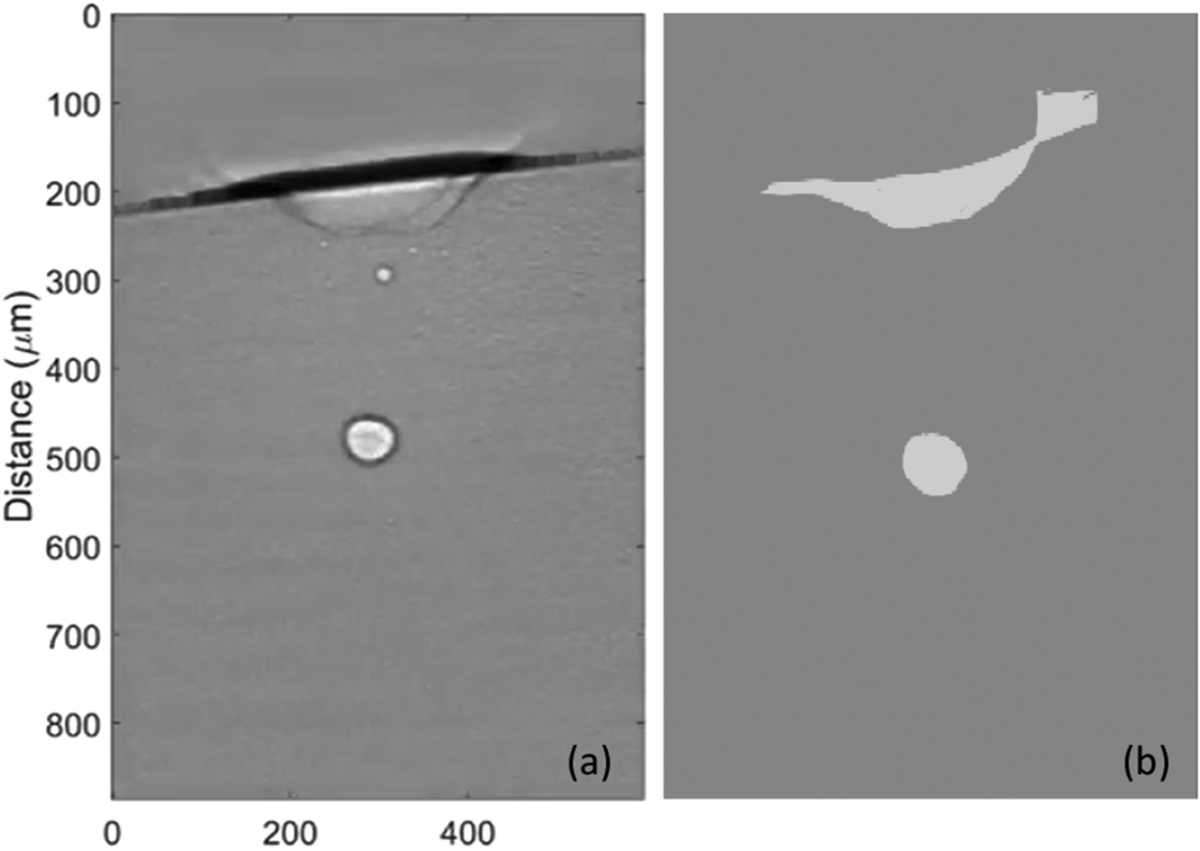
High-speed X-ray radiography can reveal melt-pool and keyhole behavior that is impossible to observe using a normal camera. These experiments are extremely valuable, but they are also expensive, specialized and time-consuming. They cannot practically cover every combination of material, laser power, beam profile, focal position and scanning strategy required for industrial development.
That is why numerical models matter. A validated simulation lets engineers run virtual experiments, isolate mechanisms and investigate quantities that are difficult or impossible to measure directly.
In Mehdi's high-fidelity model, two computational systems were coupled:
- A multiphase, multiphysics solver calculated the evolving melt pool, temperature field, fluid motion, phase change and free surface.
- A high-performance ray-tracing model calculated laser propagation, multiple reflections and the effective energy absorbed by the changing metal surface.
The surface predicted by the fluid model became the input to the optical model. The resulting laser heat flux was then returned to the fluid simulation. This coupling is essential: the laser changes the surface, and the changing surface changes how the laser is absorbed.
Validation before confidence
A simulation is useful only when its predictions are compared with reality. The model was evaluated against dynamic X-ray experiments for different materials and laser conditions, including Ti-6Al-4V and 5182 aluminium.
The reported comparison showed close agreement in laser absorption history, the transition from conduction mode to keyhole mode, average keyhole depth and the presence or absence of final pores. Across the benchmark cases, the study reported maximum deviations of 11% in average keyhole depth and deviations of roughly 2-8% in the laser-absorption time profile.
The model also revealed a deeper mechanism: the location of the maximum temperature did not always coincide with the point of maximum deposited laser energy. Tracking these two locations helped classify different keyhole shapes and explain when temporary pores separate from the keyhole.
This is exactly the type of insight simulation should provide. It should not merely recreate a colorful temperature field. It should help explain why a defect appears and what process change may prevent it.
From research model to industrial decision tool
For industry, the objective is not to simulate physics for its own sake. The objective is to reduce uncertainty before material, machine time and operator hours are committed.
A physics-based model can support:
- identification of stable process windows;
- prediction of keyhole-related porosity risk;
- evaluation of new laser profiles and scanning conditions;
- faster transfer between materials or machines;
- targeted experiments instead of broad trial-and-error campaigns;
- generation of thermal histories for later microstructure and property prediction.
It does not eliminate physical validation. It makes validation more focused and valuable.
The physics layer of the QH Build digital twin
QH Build is building on this foundation by connecting high-fidelity physics to the rest of the manufacturing system. The laser and melt pool cannot be treated separately from the robot trajectory, controller timing, wire feed, sensors and evolving part geometry.
Our direction is a physics-based digital twin in which the process model receives realistic motion and process data, runs in a GPU-accelerated environment and returns information that can improve planning and manufacturing decisions.
The long-term goal is straightforward to describe and difficult to achieve: move from observing defects after a build to predicting them before they happen.
Technical basis
- Mehdi Abdi, Salem Mosbah and Mahfoudh Ayadi, High fidelity multi-physics modeling of laser metal interaction and keyhole dynamics in powder bed fusion, Progress in Additive Manufacturing 10 (2025), 1243-1260. DOI: 10.1007/s40964-024-00702-0.